This article may contain affiliate links, including those from Amazon Associates. If you choose to purchase through them, Fox & Nook may earn a small commission at no additional cost to you. We only reference products or services we believe align with intentional, functional living. Learn more about our Affiliate Policy.
⬛ Quick Overview
What you’ll find in this slow living guide: A clear, jargon-free explanation of what slow living actually means, what it is not, and a few simple ways to begin weaving it into your everyday life, no dramatic overhaul required.
Contents:
Introduction to Slow Living
Slow living is one of those phrases that sounds immediately appealing and yet, for many people, it also sounds a little out of reach. If slow living brings to mind a remote countryside cottage, a wood-burning stove, and a completely unhurried schedule, you are not alone. That image is everywhere.
It is also, for most of us, not quite the point.
At its core, slow living is about presence over pace. It is a conscious decision to step back from the relentless rush of modern life and make room, however small, for the things that genuinely matter to you. That is something anyone can begin doing, regardless of how full their schedule already is.
This guide breaks it all down in plain English, so you can decide what slow living might look like in your own life.
What Slow Living Actually Means
The slow living movement did not emerge from a single source. It grew quietly out of several overlapping cultural shifts: the Slow Food movement of the 1980s in Italy, the minimalism conversations of the early 2000s, and a growing collective sense that modern productivity culture was asking too much of people and giving too little back.
Today, slow living is broadly understood as a lifestyle philosophy. It encourages people to move through their days with greater intention, to consume more thoughtfully, and to prioritise quality of experience over quantity of output.
Importantly, slow living does not mean slow productivity. You can have a demanding career and still practise slow living. The shift is internal as much as it is external; it is about how you approach your time, not necessarily how much of it you have.
What Slow Living Is Not
Before going further, it helps to clear up a few common misconceptions. Slow living is not:
- Laziness or disengagement. It is an active, conscious choice, not an excuse to opt out of responsibility.
- A privilege reserved for the wealthy. While some aesthetic portrayals of slow living can feel aspirational, the philosophy itself costs nothing to adopt.
- A rigid rulebook. There is no checklist to complete or standard to meet. Slow living looks different for every person who chooses it.
- Anti-ambition. Many people who practise slow living are deeply driven. They have simply chosen to direct that drive more deliberately.
Letting go of these misconceptions is often the first real step toward understanding what slow living can offer you, specifically.
The Core Principles of Slow Living
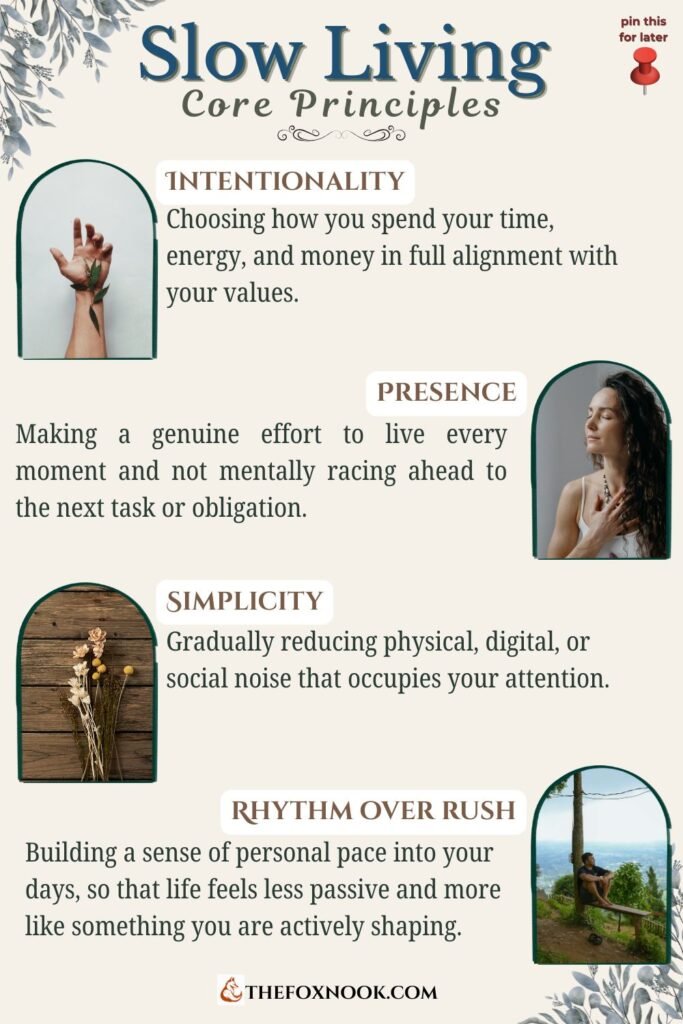
While slow living is flexible by nature, a few guiding principles tend to appear consistently across the community:
Intentionality. Choosing how you spend your time, energy, and money based on what genuinely aligns with your values rather than defaulting to habit, obligation, or outside pressure.
Presence. Making a genuine effort to be in the moment you are actually in, rather than mentally racing ahead to the next task or obligation.
Simplicity. Gradually reducing the noise, physical, digital, or social that pulls your attention away from what matters most to you.
Rhythm over rush. Building a sense of personal pace into your days, even in small ways, so that life feels less like something happening to you and more like something you are actively shaping.
None of these principles requires a lifestyle overhaul. They are orientations, not instructions.

Simple Ways to Begin Practising Slow Living
Starting your slow living journey does not have to mean starting big.
In fact, smaller lifestyle shifts and mindful self-care habits tend to be far more sustainable.
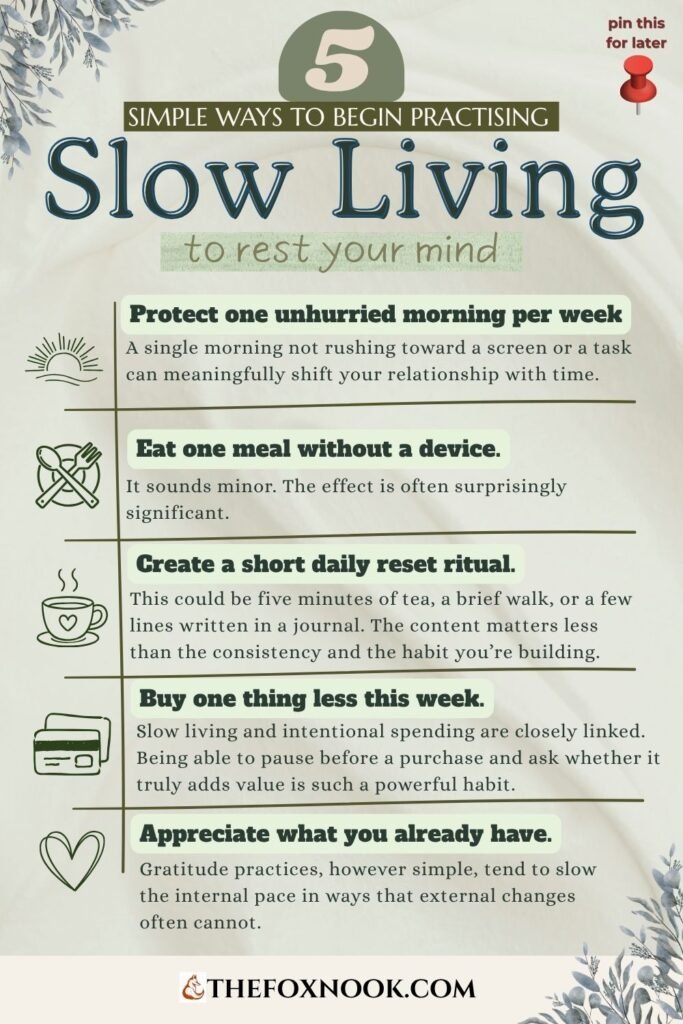
Here are a few entry points worth considering:
Protect one unhurried morning per week.
Even a single morning where you are not rushing immediately toward a screen or a task can meaningfully shift your relationship with time.
Eat one meal without a device. It sounds minor. The effect is often surprisingly significant.
Create a short daily reset ritual. This could be five minutes of tea, a brief walk, or a few lines written in a journal. The content matters less than the consistency.
Buy one thing less this week. Slow living and intentional spending are closely linked. Pausing before a purchase and asking whether it truly adds value is a small but powerful habit.
Notice what you already have. Gratitude practices, however simple, tend to slow the internal pace in ways that external changes often cannot.
None of these is prescriptive. They are simply invitations to experiment and observe what resonates with your own life and rhythm.
Slow Living and Intentional Living — What Is the Difference?
The two terms are often used interchangeably, and for good reason, they share a great deal of common ground. Both encourage thoughtful decision-making, both push back against mindless consumption, and both ask you to clarify what actually matters to you.
If there is a distinction worth drawing, it is this: slow living tends to emphasise pace and presence, while intentional living places slightly more emphasis on alignment, ensuring that your daily choices reflect your deeper values and goals. In practice, most people who pursue one end up naturally gravitating toward the other as well.
Final Thoughts
Slow living is, at its simplest, a reclaiming of your own attention. It is a quiet act of choosing ‘this’. This moment, this meal, this conversation over the endless pull of what is next.
You do not need a slower life to begin slow living.
You simply need a willingness to notice where the pace is costing you something, and the curiosity to experiment with one small change at a time.
That is more than enough to start.
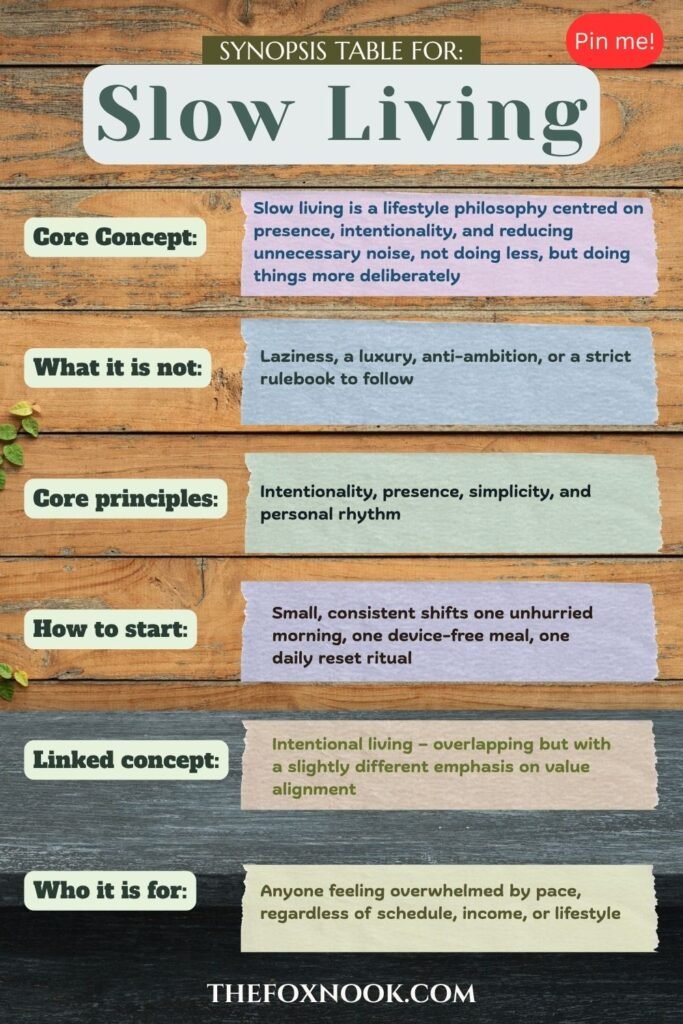
Synopsis Table
Thank you for reading our quick guide to what Slow Living is.
We think you might also like our other articles too: