

As an Amazon Associate, Fox & Nook earns from qualifying purchases. This article about laundry room organization contains affiliate links. If you choose to purchase through them, Fox & Nook earns a commission at no additional cost to you. We only reference products or services we believe align with intentional, functional living. Learn more about our Affiliate Policy.
Introduction to Laundry Room Organization
Laundry room organisation isn’t the most glamorous topic in intentional home design. However, it might be one of the most practical because, unlike a beautifully styled bookshelf or a carefully curated living room corner, the laundry space is a working area used multiple times every week. When it functions poorly, that friction compounds across every single wash cycle, every search for the right cleaning product, every hamper that overflows before it gets addressed.
In contrast, a laundry space that is genuinely well-organized, where supplies are easy to find, hampers are properly sized for your household, and the workflow from dirty to clean to folded is as smooth as it can be, is one of those quiet household improvements that makes daily life meaningfully easier without requiring much thought once it’s in place.
As a result, this guide approaches laundry room organisation the same way Fox & Nook approaches any home system: not as an aesthetic project, but as a functional one. The goal is a space that works for your actual laundry habits, reduces the mental and physical effort involved, and stays organised without requiring constant maintenance.
Whether you have a dedicated laundry room, a washer-dryer in a kitchen cupboard, or a shared utility space, the same principles apply, and most of the storage solutions and organizational ideas here scale to fit.
Laundry Room Organization: Quick Overview
This laundry room organization guide covers:
- starting with the right laundry hamper setup
- laundry room storage ideas that actually work
- organizing your cleaning supplies and laundry detergent
- making the most of a small laundry space
- the laundry room decor details that make a space feel considered
- a simple laundry habit system to keep it all maintained
- a summary of the key products and ideas
- FAQs for Laundry Room Organization
Start With the Right Laundry Hamper Setup
Before addressing shelving, storage, or cleaning supplies, the single most impactful starting point for laundry room organization is the hamper because it determines how laundry is collected, sorted, and managed before it ever reaches the machine.
Most households underinvest here. A single, oversized laundry hamper that accumulates everything until it overflows is one of the most common sources of laundry-related friction: sorting happens at the worst possible moment (in front of the machine, when you’re already committed to doing a wash), the volume is overwhelming rather than manageable, and there’s no visual signal that it’s time to do a load until it’s already too late.
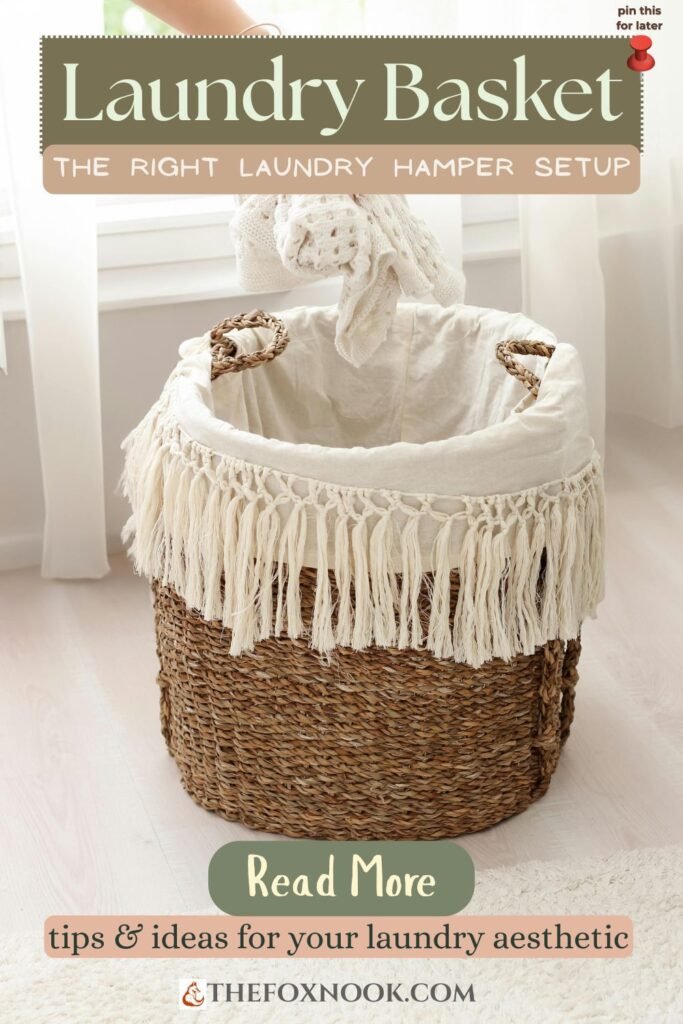
A better approach: sort at the point of deposit
A divided hamper or two to three separate hampers designated for different categories means sorting happens passively, as a natural part of putting clothes away. By the time a hamper is full, a load is ready to go directly into the machine without any additional handling.
Useful categories to separate include lights and darks, everyday clothing and bedding or towels, or delicates and standard items, depending on how your household typically washes. The right division is the one that reflects your actual laundry habits rather than a theoretical system.
What to look for in a laundry hamper
Ventilation matters for hampers that hold clothing for more than a day or two. Woven or mesh designs allow airflow that prevents odour from building.
Capacity should match your laundry frequency: a smaller hamper that triggers a wash every two to three days is more manageable than a large one that holds a week’s worth and produces an overwhelming single session.
Portability: A hamper with handles or a removable liner makes moving a full load to the machine considerably easier and is worth prioritising over purely aesthetic considerations.
Our recommendations:
Divided laundry hampers:
→ CASAMAYA Laundry Basket with Lid, Laundry Hamper 3 Section
See current price on Amazon
Slimmer option:
→ Corner Heavy-Duty Canvas Hamper w/Wheels, 24″W x 17.7″D, Natural White
See current price on Amazon
As an Amazon Associate, Fox & Nook earns from qualifying purchases.
Laundry Room Organization: Storage Ideas That Actually Work
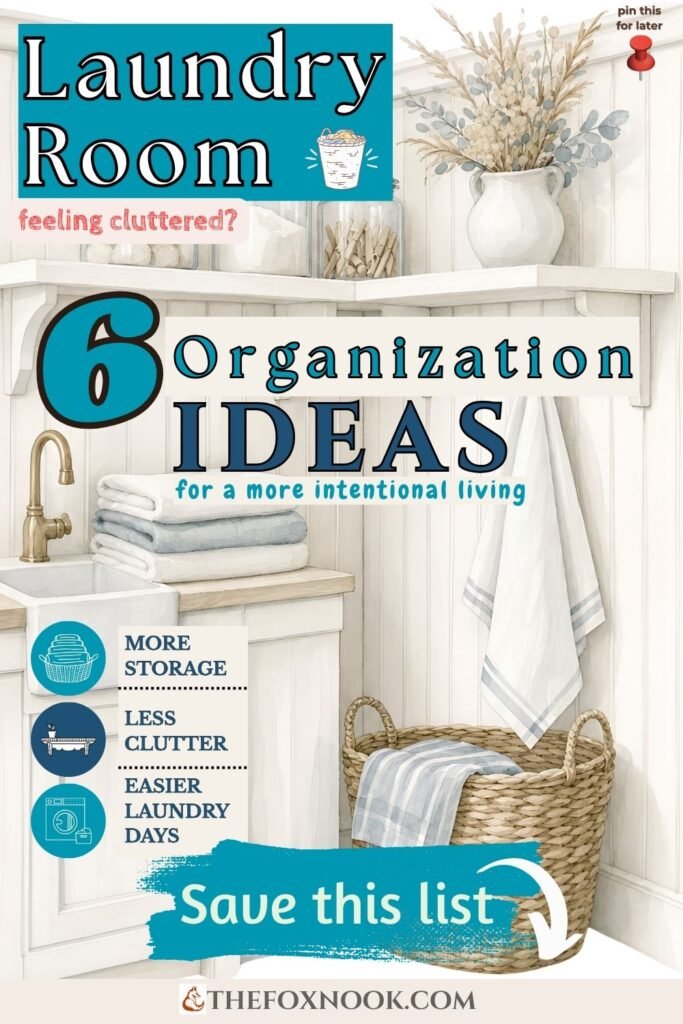
Once the hamper situation is addressed, the next layer of laundry room organization is storage, specifically, making the supplies and tools you use regularly accessible without cluttering the working area.
The principle here mirrors the broader home organization approach: everything used regularly should have a designated, logical home that requires minimal effort to return to. Supplies that are awkward to access get used inconsistently. Surfaces that accumulate items without a system quickly become visual noise that makes the space feel more chaotic than it needs to.
Vertical space is your best asset
In most laundry spaces, particularly small ones, the wall above the washer and dryer is the most underused storage resource available.
Furthermore, vertical storage keeps the working surface clear, which makes the actual task of doing laundry considerably less effortful.
Practical vertical storage options include:
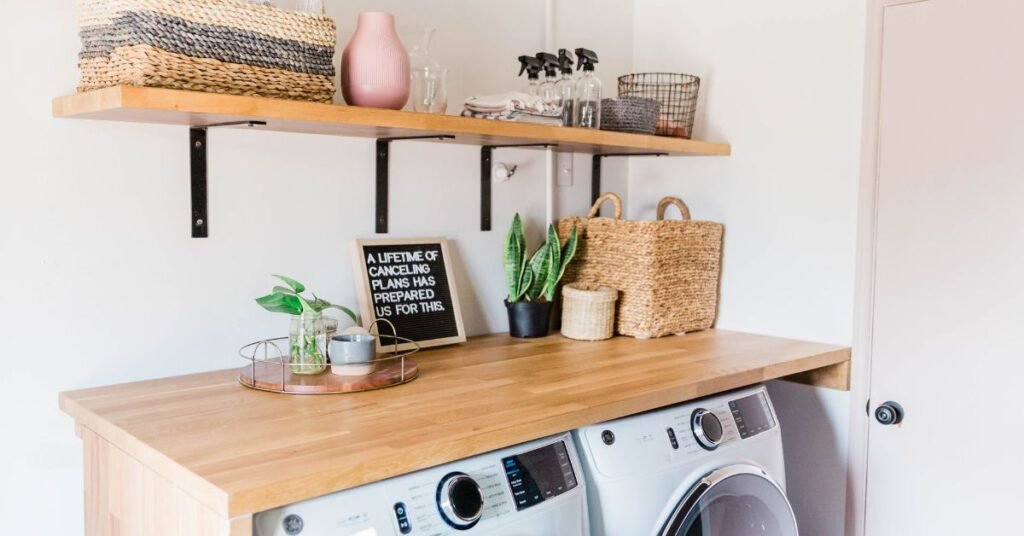
Floating shelves positioned above the appliances for cleaning supplies, laundry detergent, and folded items. These are among the most effective and affordable laundry room storage ideas available. A single well-positioned shelf above the washer changes the functional quality of the space immediately.
Wall-mounted cabinets offer the same benefit with the addition of concealment, which is worth considering if the laundry space is visible from an adjoining room or if you prefer a cleaner visual finish.
Over-door organizers make excellent use of the space behind a door for an ironing board, a drying rack, or smaller cleaning supplies that would otherwise take up shelf space.
On the countertop or folding surface
If your laundry space includes a countertop above a front-loading machine or a dedicated folding surface, keeping it clear for its primary purpose is worth a specific intention.
A single small caddy or tray holding the supplies used for every wash (detergent, fabric softener, stain remover) contains what’s needed without allowing the surface to become a general deposit zone.
Our recommendations:
Floating Shelves:
→ Homeforia 24 Inch Floating Shelves, High-End Solid Pine Wood, Set of 2
See current price on Amazon
→ QEEIG Bathroom Shelves with Decor Sign (Brown, 15.7″)
See current price on Amazon
→ AquaTeak The Original 24″ Moa Teak Wall Shelf with Hooks
See current price on Amazon
Wall-mounted storage cabinets:
→ Wall Cabinet Bathroom Storage Cabinet Wall Mounted with Adjustable Shelves Inside
See current price on Amazon
→ Keonjinn 16″ x 24″ Black Medicine Cabinet Mirror, Stainless Steel Framed
See current price on Amazon
→ Fluted Bathroom Wall Cabinet with Tambour Sliding Door, Walnut
See current price on Amazon
Over-door organisers:
→ Over the Door Organizer for Bedroom, Pantry, Bathroom, 5 Shelf Grey
See current price on Amazon
→ Over The Door/Wall Mount Ironing Board Hanger, Laundry Room Iron and Ironing Caddy Board Storage Holder, Black
See current price on Amazon
As an Amazon Associate, Fox & Nook earns from qualifying purchases.
Organising Your Cleaning Supplies and Laundry Detergent
Laundry supplies have a way of multiplying. A backup detergent was bought before the current one ran out. A stain remover was acquired for a specific incident and then kept indefinitely. Several cleaning products overlap in function. The result, in most laundry spaces, is a collection of bottles and boxes that takes up more space than it should and makes it harder to find what’s actually needed. That severely, and quite quickly negatively impacts your laundry room organization as a whole.
Consequently, an organized laundry supplies system starts with an honest review of what’s actually there and what’s actually used.
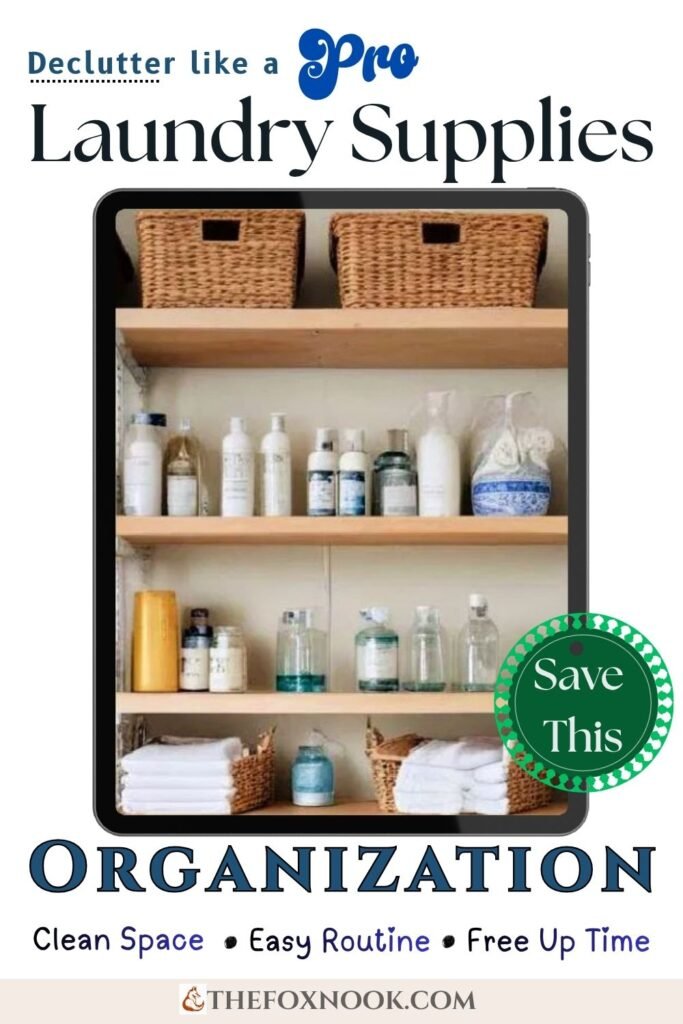
Simplify before you organise
Before investing in new storage, a useful first step is to gather everything currently in the laundry space and assess it clearly. Consolidate duplicates. Discard anything empty or expired. Identify the three or four products used in every single wash: typically a main laundry detergent, a fabric conditioner, a stain treatment, and a colour or whitening product. These are the ones that deserve prime, accessible placement. Everything else can be stored further back or lower down.
Decanting for everyday supplies
For frequently used laundry detergent and fabric softener, decanting into uniform, labelled containers / dispensers with clear measurement markings, or simple airtight containers is a small change that improves the experience of doing laundry noticeably.
Moreover, it reduces the visual noise of multiple different branded packaging competing for attention on the shelf, and makes measuring straightforward rather than approximate.
This is particularly effective for powder detergents and for households that buy in bulk: a smaller, accessible container on the shelf and a larger refill container stored out of the way is a practical system that balances convenience with economy.
Cleaning products beyond laundry
If your laundry space doubles as a storage area for household cleaning products more broadly, the same principle applies: group by function, place the most-used items at the most accessible height, and contain each category in its own tray or basket so that reaching for one product doesn’t disturb the entire shelf. This might seem like a small thing, but it will do wonders for your overall laundry room organization!
You can learn more about reducing laundry product waste here.
Our recommendations:
Laundry detergent dispensers:
→ 2 Pcs Glass Laundry Detergent Dispensers with Pumps, 64 Oz Bottles
See current price on Amazon
→ Skywin Liquid Laundry Detergent Holder Stand – 1 Pack – Black with Print
See current price on Amazon
→ Laundry Detergent Holder Stand with Drip Tray, Black Frame & Natural Wood
See current price on Amazon
Matching decanting containers:
→ 4 Pack Bathroom Organizers and Storage – Glass Qtip Holder & Cotton Pad Dispenser with Lid
See current price on Amazon
→ Amolliar Acrylic Apothecary Jar Bathroom Qtip Holder Black 6 Pack
See current price on Amazon
As an Amazon Associate, Fox & Nook earns from qualifying purchases.
Making the Most of a Small Laundry Space
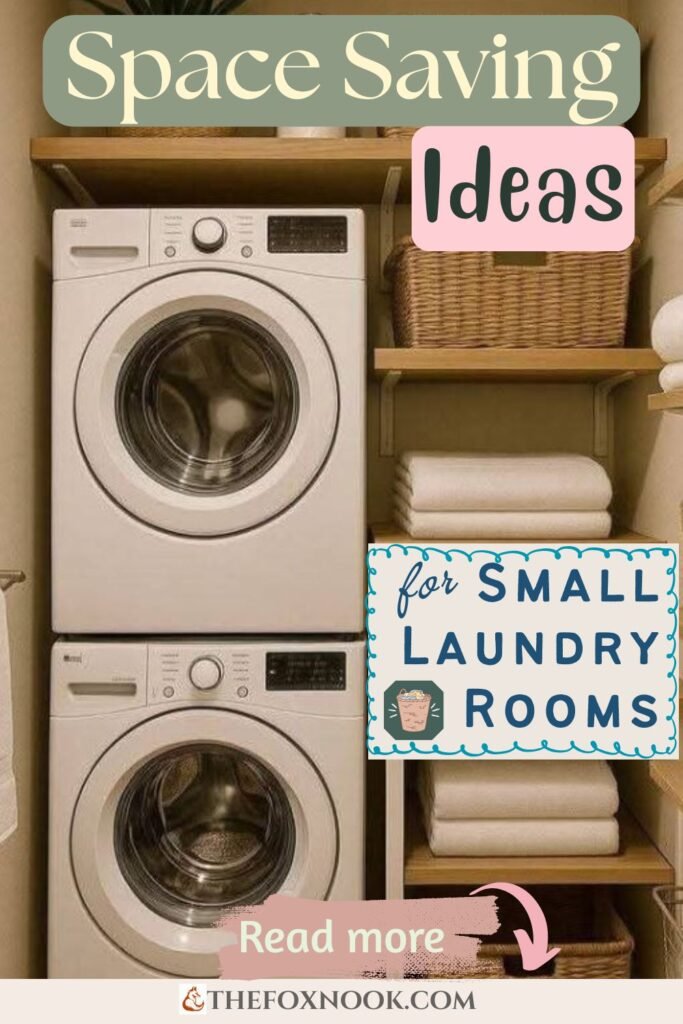
Not every home has a dedicated laundry room, and for those working with a stacked washer-dryer in a cupboard, a machine in the kitchen, or a shared utility corner, the organizational principles are the same, but the spatial constraints require a more deliberate approach.
In a small laundry space, every decision about what occupies the area needs to earn its place more rigorously than in a larger one. Additionally, the design of the space needs to work harder, because there’s less room to absorb disorder before it becomes a problem.
Space-saving ideas for small laundry areas
Stacking, where possible, a stacked washer-dryer unit, or a dryer mounted on a dedicated stacking kit above a front-loader immediately frees floor space for a slim hamper or a small rolling cart. If your appliances aren’t currently stacked and the configuration allows it, this is often the single most impactful spatial change available in a small laundry setup.
A fold-down ironing board mounted to the wall replaces a free-standing board that takes up significant floor space when stored. In a small laundry space, the floor area saved is meaningful, and a wall-mounted board is immediately accessible without needing to be retrieved from storage.
Slim, vertical hampers work considerably better than wide, low ones in tight spaces. A tall, narrow hamper occupies a small footprint while still holding a reasonable volume and fits naturally beside or between appliances in a way that a standard-width hamper doesn’t.
A magnetic or adhesive side panel on the washing machine itself can hold a small selection of frequently used supplies, such as a lint brush, a stain remover pen, and a measuring scoop, keeping them accessible without requiring any additional shelf space.
Our recommendations:
Laundry room organization cart:
→ Slim Laundry Room Organization Cart with Upgraded Metal Hub Casters
See current price on Amazon
→ Laundry Room Organization and Storage Magnetic Dryer Ball Holder with Magnetic Hanger Holder
See current price on Amazon
As an Amazon Associate, Fox & Nook earns from qualifying purchases.
The Laundry Room Decor Details That Make a Space Feel Considered
A laundry space doesn’t need to be beautiful to function well.
Nevertheless, since it’s a space visited multiple times each week, the visual experience of it is worth a small degree of attention, not for aesthetic performance, but for the same reason that any frequently visited space benefits from feeling calm and considered rather than purely utilitarian.
Laundry room decor, within an intentional living framework, is simply about removing visual friction and adding a small amount of personality. It doesn’t require a renovation budget or a styled shoot.

Small details with a meaningful effect
Consistent, matching containers for laundry supplies, even simple glass or ceramic dispensers, rather than a collection of mismatched branded bottles, create a visual calm that makes the space feel more settled. The product itself doesn’t change; the experience of the space does.
A single plant on a shelf or windowsill, if light allows, a hardy variety like a pothos or a snake plant that tolerates humidity without complaint, adds a note of life to what is often a purely functional space. As explored in our slow living home swaps post, even a small natural element meaningfully changes how a space feels.
Proper lighting in a laundry space is often neglected because the space is functional rather than social. However, a brighter, warmer bulb in the existing fitting, or a small plug-in light if the current lighting is poor, makes the space easier to work in and considerably less dispiriting to visit.
A hook or two on the wall beside the machine for items that need to hang to dry, for reusable bags, or simply for the laundry bag you carry between rooms is a small addition that removes a common source of surface clutter.
Our Laundry room decoration recommendations:
Laundry room wall art:
→ Poster Master 2-Piece Essential Guide for Laundry Print – Stain Removal Poster – Infographic Art
See current price on Amazon
Funny gift for Laundry room:
→ Laundry Room Decor Loads Fun Sign, Rustic Wooden Wreath All Seasons Gift
See current price on Amazon
As an Amazon Associate, Fox & Nook earns from qualifying purchases.
A Simple Laundry Room Organization Habit System to Maintain It
Laundry room organisation systems only work as long as the habits that support them are in place. Consequently, the most important element of laundry room organisation isn’t any particular storage product; it’s a simple, sustainable routine that keeps the space functioning without requiring constant effort.
The laundry room habit principles that keep a laundry space working
→ Wash at a consistent frequency rather than reactively. A regular laundry day or two built into the weekly routine removes the accumulation that leads to overwhelming sessions and an overflowing hamper. Combined with a weekly reset routine, a consistent laundry rhythm is one of the household habits that contributes most directly to a sense of ongoing order at home.
→ Return supplies to their designated place after every use. This is the simplest and most important maintenance habit in any organized space, and your laundry room organization is no exception. Supplies left on the countertop after a wash rather than returned to the shelf are the beginning of the drift that gradually undoes an organised system. The return takes seconds; the restoration of an undone system takes considerably longer.
→ Do a brief laundry space reset weekly. Not a deep clean, simply a check that everything is in its place, that supplies are adequately stocked, and that the hampers are at a manageable level. Five minutes as part of a broader home reset prevents small disorder from compounding into a larger one.
→ Stock supplies before they run out, not after. Running out of laundry detergent mid-cycle is a small but disproportionately irritating household friction. A simple habit of noting when a supply is running low during the weekly reset, or when the container is approaching empty, and replenishing it before it runs out, removes this friction entirely.
Summary: Laundry Room Organisation at a Glance
Area | The Key Idea |
Sort at the point of deposit, divide by category to remove pre-wash sorting effort | |
Use vertical space above appliances; keep the working surface clear | |
Simplify first, then organise; decant everyday products into consistent containers | |
Stack appliances where possible; use slim hampers and fold-down solutions | |
Consistent containers, one plant, better lighting, a hook or two | |
Regular laundry days, return supplies after use, brief weekly reset |
Frequently Asked Questions & Tips for Laundry Room Organization
What is the best way to organise a laundry room?
The most effective approach starts with the hamper setup, sorting laundry at the point of deposit, rather than in front of the machine, which removes the most common source of friction.
From there, vertical storage above the appliances for supplies, a clear and accessible system for laundry detergent and cleaning products, and a consistent weekly laundry rhythm together produce a space that functions well without requiring ongoing management.
The specific storage products matter less than the underlying logic: everything used regularly should have a clear, accessible home, and the working surface should be kept clear for its primary purpose.
How to organize laundry supplies in a small space?
In a small laundry space, vertical organization is the primary tool. A shelf or two above the washer and dryer, a slim caddy that holds the supplies used in every wash, and a magnetic or adhesive panel on the side of the machine for small, frequently-used items collectively provide functional storage without requiring floor or counter space.
Decanting laundry detergent and fabric softener into smaller, uniform containers reduces both visual clutter and the physical footprint of the supply area considerably.
What laundry supplies do I actually need?
The core laundry supplies for most households are: a main laundry detergent suited to your machine type, a fabric conditioner, a stain remover or pre-treatment product, and optionally a colour-care or whitening product for specific loads. Beyond these four, most additional laundry products overlap in function with something already in the collection. Simplifying to a small, well-chosen set of supplies that you actually use consistently is more practical and more economical than maintaining a large, overlapping collection.
How do I keep a laundry room tidy long-term?
The two habits that matter most are: returning supplies to their designated place immediately after use, and doing a brief five-minute reset of the laundry space as part of a weekly home routine. Between these two habits, the space rarely has the opportunity to drift into disorder, which means the organized system established at the outset continues to work without requiring periodic major reorganization.
Can laundry room organization actually save time?
Yes, and the saving is more significant than it might appear. When laundry is already sorted into separate hampers, there’s no pre-wash sorting time. When supplies are accessible and in a logical place, there’s no searching time. When the space is visually calm and uncluttered, the mental friction of starting a wash is lower.
Moreover, a consistent laundry routine eliminates the decision-making overhead of figuring out when to do laundry. The cumulative time and mental energy saved across a full year of weekly laundry sessions is meaningful even if the savings per session are only a few minutes.
What's the difference between laundry room organization and laundry room decor?
Laundry room organization addresses function: how the space works, how efficiently laundry moves through it, and how easy it is to find and use supplies.
Laundry room decor addresses experience: how the space feels to be in, its visual quality, and the small details that make it feel considered rather than purely utilitarian.
In practice, the two overlap considerably; consistent, well-chosen containers are both an organizational choice and an aesthetic one. The most useful starting point is always function, with decor as a secondary layer added once the system works. A beautiful laundry space that doesn’t function well is considerably less useful than an ugly one that does.
A Laundry Space That Works for You..!
The laundry space is never going to be the most celebrated room in the home. Nevertheless, it’s one of the most consistently used, which means the quality of its organization has a disproportionate effect on the quality of the daily household experience.
A well-considered laundry room organization, with a proper hamper setup, logical storage for supplies, and a simple maintenance habit are all that’s needed to transform a laundry space from a source of low-level friction into something that simply works. That quiet transformation of a space that asks nothing of you beyond putting clothes in and taking them out is exactly what intentional home design is for. ❤️

Thank you for reading our Laundry Room Organization Guide!