
Disclosure:
This article may contain affiliate links. If you choose to purchase through them, Fox & Nook may earn a small commission at no additional cost to you. We only reference products we believe align with intentional, functional living.
How to upgrade your daily life without adding clutter

When you hear the word “minimalism,” what image comes to mind?
For many of us, it’s a visual one. White walls. Sparse shelves. A single ceramic vase on an otherwise empty table. Minimalism as aesthetic—clean, photogenic, and just a little bit aspirational.
But here’s what those beautiful images don’t show you: the feeling.
Because minimalism, in practice, isn’t really about how a room looks. It’s about how it feels to be in it.
It’s the quiet relief you experience when you walk through your door after a long day, and your shoulders don’t instinctively tense. It’s the absence of friction when you reach for what you need, and it’s exactly where it should be. It’s the subtle exhale when your eyes land on a clear surface, and for a moment, nothing is demanding your attention.
In smaller homes, especially, friction compounds quickly.

A misplaced charger becomes a daily micro-annoyance. A cluttered entryway becomes background stress you stop noticing, but never stop feeling. Harsh overhead lighting keeps your nervous system subtly alert, even hours after sunset.
These aren’t failures of aesthetics. They’re failures of function, and they affect your experience of home more than any design magazine spread ever could.
The upgrades we have put together in this article won’t make your home look emptier. That’s not the intention. Instead, they’re designed to make it easier to live in, more responsive to your actual needs, less demanding of your attention, and more restful for your nervous system.
They’re thoughtful, research-informed shifts that improve daily life in measurable, psychological ways. No unnecessary consumption. No trend-chasing. Just small adjustments that add up to something meaningful.
A note before we begin:
These upgrades aren’t a checklist. You don’t need to do them all. Read through, notice which ones resonate with a current friction point in your home, and start there. Even one small change can shift how your space feels.
1. Redesign Your Entry Point: The Most Important 30 Seconds of Your Day
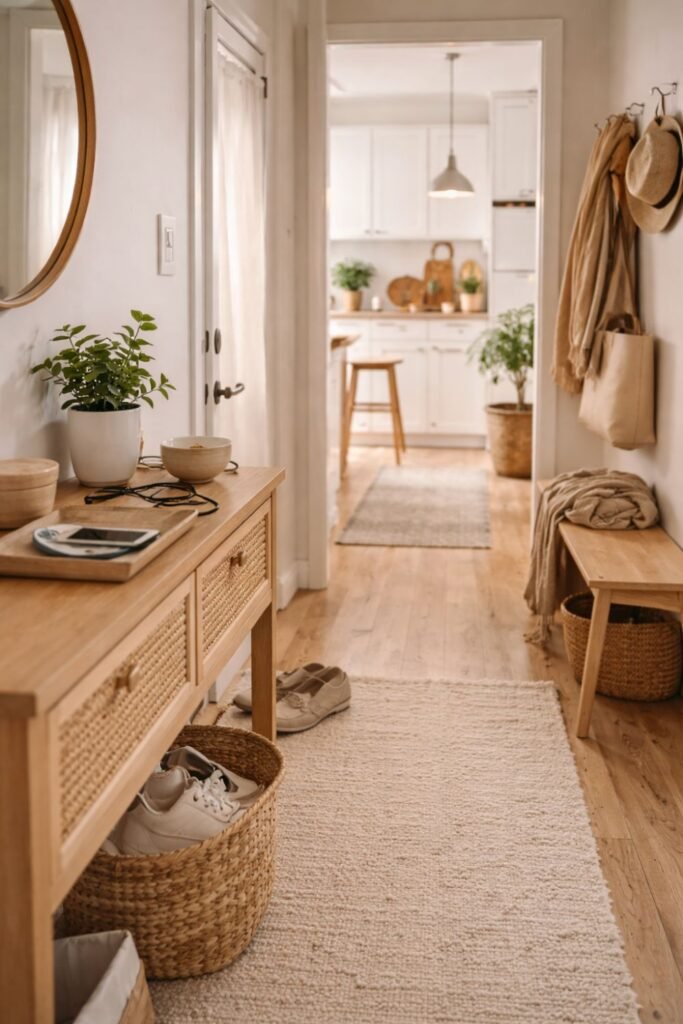
The first thirty seconds after you walk through your door matter more than most of us realize.
You’ve just come home. Perhaps it was one of those really stressful days at work, maybe traffic was heavy, or maybe you’ve just finished shopping, and you’re carrying groceries, a bag, the mental weight of everything still undone. You step inside, close the door behind you, and…
What do you see?
If it’s chaos, scattered shoes, yesterday’s mail, misplaced keys, bags slumped where they landed, your brain registers it immediately. Not in a dramatic way. Not with conscious thought. But in that subtle, background hum of processing.
Environmental psychology research confirms what you already feel: visual disorder increases cognitive load. Your brain has to sort through what it’s seeing, make sense of it, and file it away, all while you’re still shrugging off your coat and trying to transition from “out in the world” mode to “home” mode.
That processing feels like low-grade stress. And when it happens every single day, it compounds.
The good news? Even in the smallest apartment, you can create a defined entry zone that catches you rather than confronts you. A place where things land with intention, not chaos.
It doesn’t require a renovation or a dedicated mudroom. Just a few small anchors:
- A slim wall-mounted hook rail for coats and bags. Vertical, unobtrusive, and instantly usable.
- A narrow bench with hidden shoe storage if you have the depth; otherwise, a simple low shelf or basket works beautifully.
- A small tray or bowl, just one, designated for keys, wallets, and the small essentials that tend to vanish at the worst moments.
Here’s what makes this work:
The purpose isn’t decoration. It’s closure.
When every item has an assigned home, even a simple one, your brain stops having to track them. You’re not mentally scanning for your keys as you rush out. You’re not stepping over shoes the moment you walk in. The micro-frustrations that used to punctuate your arrivals and departures simply… fall away.
In compact spaces, vertical solutions are especially kind and rewarding. A hook rail uses wall space, not floor space. A narrow bench adds function without stealing square footage. You’re not sacrificing precious room; you’re adding structure within the room you already have.
The goal isn’t a picture-perfect entryway. It’s a transition that asks less of you, so you can actually arrive.
2. Replace Harsh Overhead Lighting with Warm, Layered Light
We spend a lot of time thinking about how our homes look. The paint colors, the furniture arrangement, the decorative touches. And yes, those matter.
But have you ever considered how your home lights you?
Not just illuminates. Lights. The way a restaurant dims its lights in the evening to encourage relaxation. The way a café positions lamps to create cozy corners. The way a single bedside lamp can transform a bedroom from functional to soothing.
Light isn’t just about seeing. It’s about feeling.
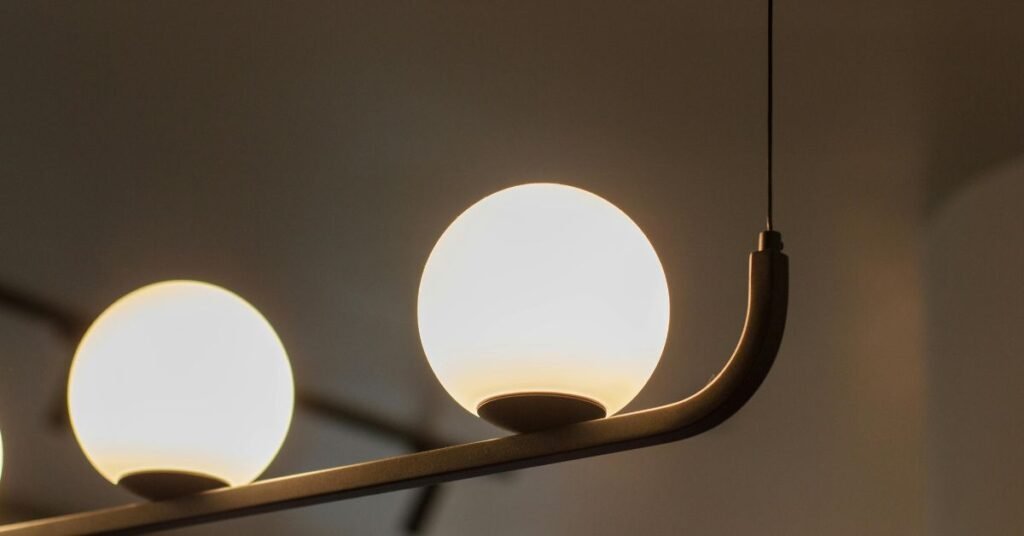
Here’s what’s happening beneath the surface:
Bright overhead lighting serves a purpose. It signals productivity. It keeps cortisol (that alertness hormone) subtly elevated. At 10 a.m., when you’re tackling your to-do list, that’s genuinely useful.
But at 8 p.m., when you’re finally home and hoping to unwind? That same bright ceiling light is still signaling alertness. Your nervous system doesn’t automatically know it’s evening just because the clock says so. It’s responding to the environment you’ve created.
This is why one of the most transformative upgrades you can make requires no renovation, no construction, no permanent change: replace your reliance on overhead lighting with layered, warm light.
What this looks like in practice:
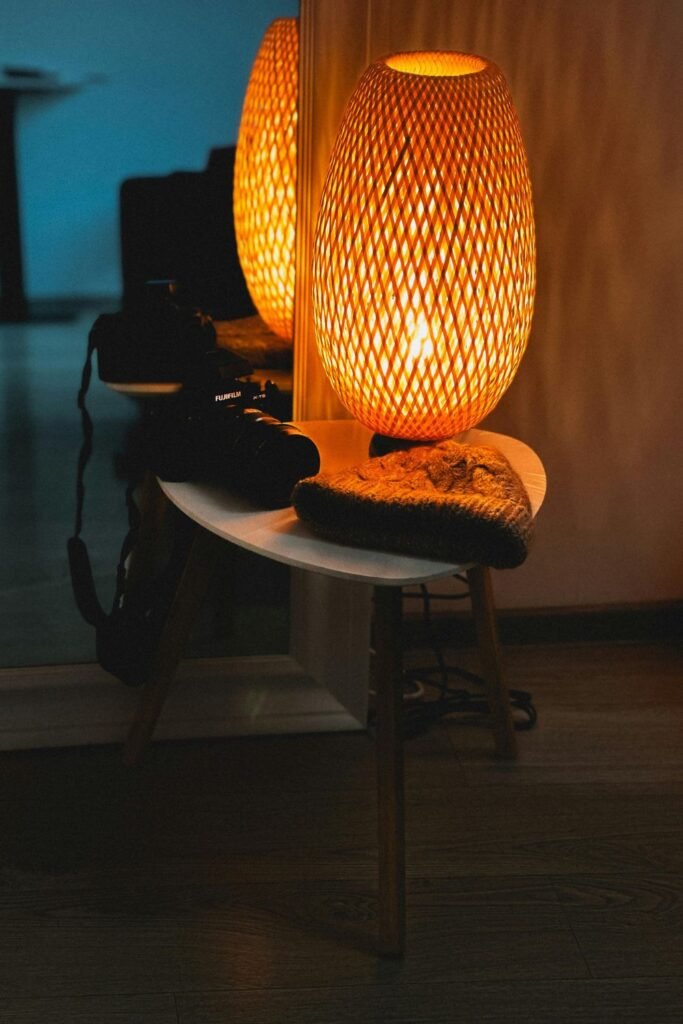
- A dimmable floor lamp in your living area becomes your primary evening light source. Bright enough for reading when you need it, soft enough for winding down when you don’t.
- A warm bedside lamp replaces your overhead bedroom light. You transition from awake to asleep without that harsh final click of the ceiling switch.
- A soft table lamp positioned slightly below eye level creates pools of gentle light that feel inherently restful.
No glare, no demand, just warmth.
The science (in case you’re curious):
Light bulbs are labeled by color temperature, measured in Kelvins (K). The lower the number, the warmer the light.
- Candlelight sits around 1500K. That’s that deep, flickering amber.
- Traditional incandescent bulbs hover around 2700K.
- Daylight bulbs clock in at 5000K or higher. That’s that crisp, blue-toned light that mimics midday sun.
For evening hours, you’re looking for bulbs in the 2700K–3000K range. Warm white. The kind of light that doesn’t shout, but settles.
Research in circadian rhythm regulation confirms what your body already knows: warmer light encourages the transition from alertness toward rest. It signals to your brain that the day is easing into evening.
The quiet magic of this shift:
These changes are small. A different bulb. A new lamp. A habit of reaching for the dimmer switch instead of the ceiling light.
But their effects compound. Night after night, your nervous system receives the same gentle message: It’s okay to rest now. And over time, that message becomes easier to hear. You’re not just changing how your home looks after dark. You’re changing how it feels to be in it.
3. Give Your Eyes (and Brain) a Rest with Closed Storage
Open shelving has had a well-deserved moment. Those carefully styled shelves with ceramics and stacked books? They photograph beautifully, and they can feel so aspirational.
But here’s what the beautiful photos don’t show you: living with constant visibility is actually quite demanding.
Every object you see, even subconsciously, requires a tiny bit of your brain’s processing power. Your mug. That stack of mail. The remote. A candle you haven’t lit in months. Multiply that by dozens, or hundreds of exposed items across a room, and your brain quietly starts working overtime. It’s like having fifty browser tabs open in your mind, all the time.
This is why closed storage isn’t just about “hiding things.” It’s about giving your brain permission to stop processing.
When you close a cabinet door on a collection of items, you’re not denying they exist. You’re simply telling your visual cortex, “You don’t need to attend to this right now.” And your brain thanks you for it.
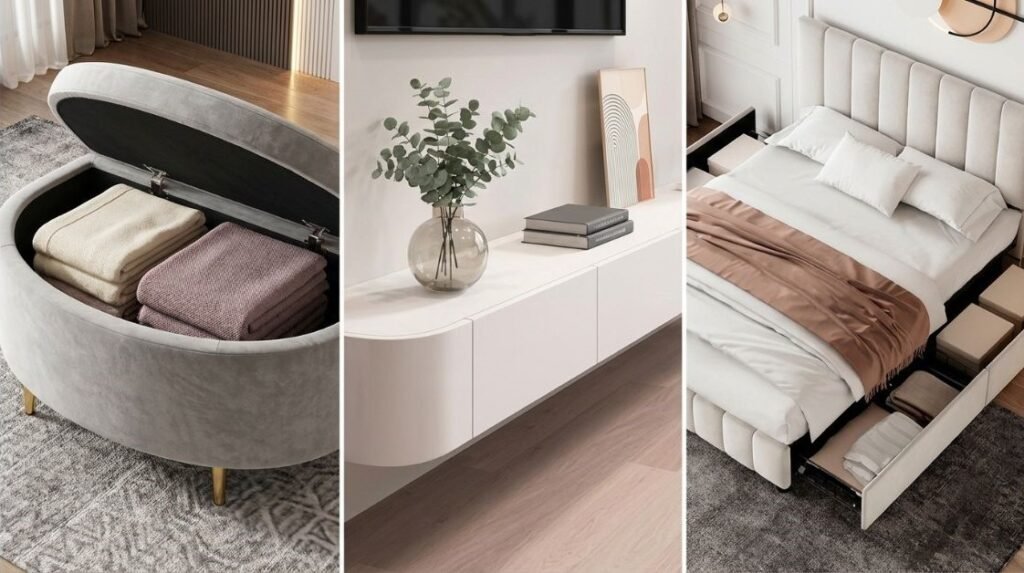
Here is how this could work beautifully in smaller homes:
- A storage ottoman in the living room holds blankets, extra pillows, or magazines while doubling as a footrest or extra seating when friends pop over.
- A media console with doors hides the inevitable tangle of cables and electronics, so your eye rests on the room, not the tech.
- A bed frame with drawers transforms the space beneath your bed from a dusty catch-all into intentional, accessible storage for linens or off-season clothing.
- A slim sideboard in a dining area or entryway can conceal everything from board games to winter gloves, all while providing a surface for a lamp or a bowl for keys.
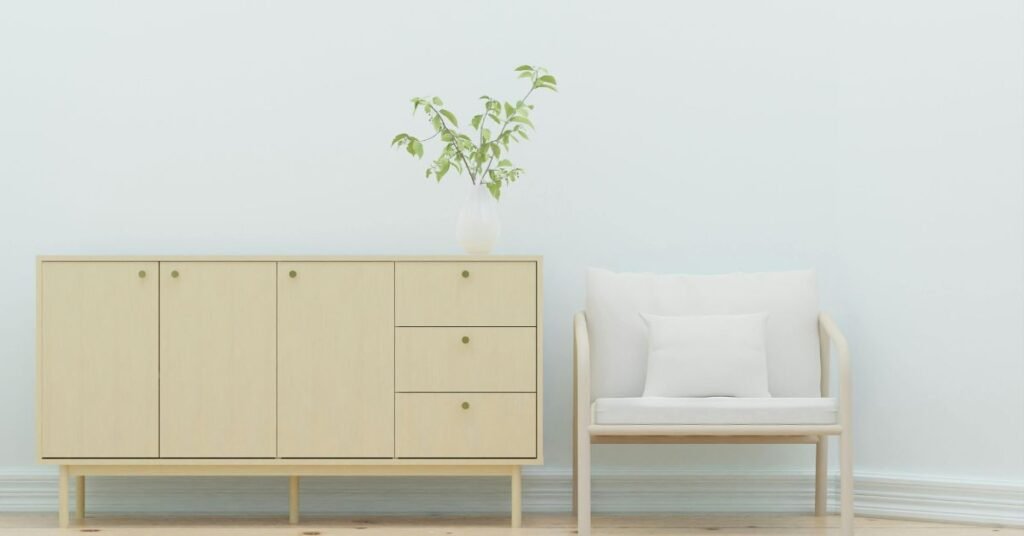
Essentially, the real benefit here isn’t a minimalist look. It’s cognitive quiet. It’s the feeling of walking into a room and exhaling, because nothing is demanding your attention.
And in smaller spaces, this matters even more. When your square footage is limited, every piece needs to earn its keep. That’s why dual-purpose furniture, like a storage ottoman or a bed with drawers, feels less like a compromise and more like a small stroke of genius. It’s minimalism that actually functions.
4. Upgrade the One Place You Spend a Third of Your Life: Your Bed
Let’s reframe something right now: Sleep isn’t a luxury.
It’s not a reward for a productive week, nor something you can sacrifice indefinitely without consequence. Sleep is infrastructure and the foundation upon which everything else in your day is built.
Think about it this way: when your mattress isn’t working for you when it’s too soft, too firm, or simply past its prime, you don’t just feel it at night. You feel it the next afternoon, in the fog of a 3 p.m. slump. You feel it in your patience with a partner or your kids. You feel it in the energy you don’t have for that evening walk or that hobby you used to love.
Quality sleep (or the lack of it) touches everything:
- Decisions feel harder when you’re tired. Small choices become draining.
- Emotions sit closer to the surface. Patience thins. Irritability thickens.
- Focus scatters. That task that should take twenty minutes stretches into an hour.
- Your body recovers more slowly, whether from a workout or just the general wear of daily life or a demanding lifestyle.
This isn’t about chasing some idealized version of “perfect sleep.” It’s about removing a source of friction that’s been quietly draining you, night after night.
What if a new mattress isn’t in the budget right now?
We appreciate the concern or the limitation. A quality mattress is a significant investment, and not something to rush into. But here’s where a small upgrade can make a surprisingly large difference: a mattress topper.
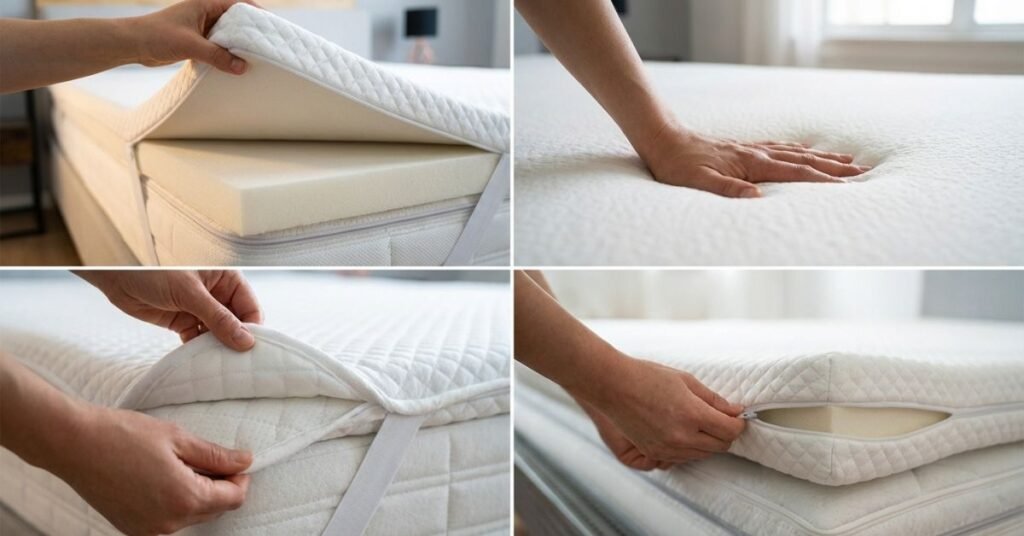
A well-constructed topper can:
- Add pressure-relieving cushioning to a mattress that’s too firm.
- Provide support to one that’s starting to sag.
- Extend the life of a perfectly good mattress that just needs a refresh.
The beauty of this upgrade is that it adds zero visual clutter to your space. No one will see it. But you? You’ll feel it every single morning. This isn’t about creating a luxurious hotel aesthetic in your bedroom. It’s about honoring the simple fact that you spend roughly eight hours a night on this surface. And those eight hours shape the other sixteen. That’s not luxury. That’s just taking care of your baseline.
5. Tame the Digital Clutter You’ve Learned to Tolerate
Here’s something curious about modern living: we’ve become remarkably good at ignoring digital clutter, even though it surrounds us constantly.
Physical clutter, be it a pile of mail or an unmade bed, catches our eye immediately. But the tangle of cables behind the nightstand? The charging bricks competing for outlet space on the kitchen counter? The black cords snaking across the desk like electronic vines? We’ve learned to look past them.
And yet, they’re still there. Still registering, somewhere in our peripheral awareness.
This is the quiet genius of containing your cables and devices: it removes a source of mental noise you may not have even realized was there.
What this looks like in practice:
- A cable management box lives near your desk or entertainment center, hiding the power strip and its tangled nest of cords. You plug everything in once, close the lid, and suddenly your visual field is clear. No more blinking lights. No more spaghetti junction.
- A designated charging drawer in the kitchen or entryway becomes the home for everyone’s devices. Phones, tablets, e-readers, they all charge in one contained space, out of sight. The counter stays clear. The morning rush no longer includes a hunt for where someone left their iPad.
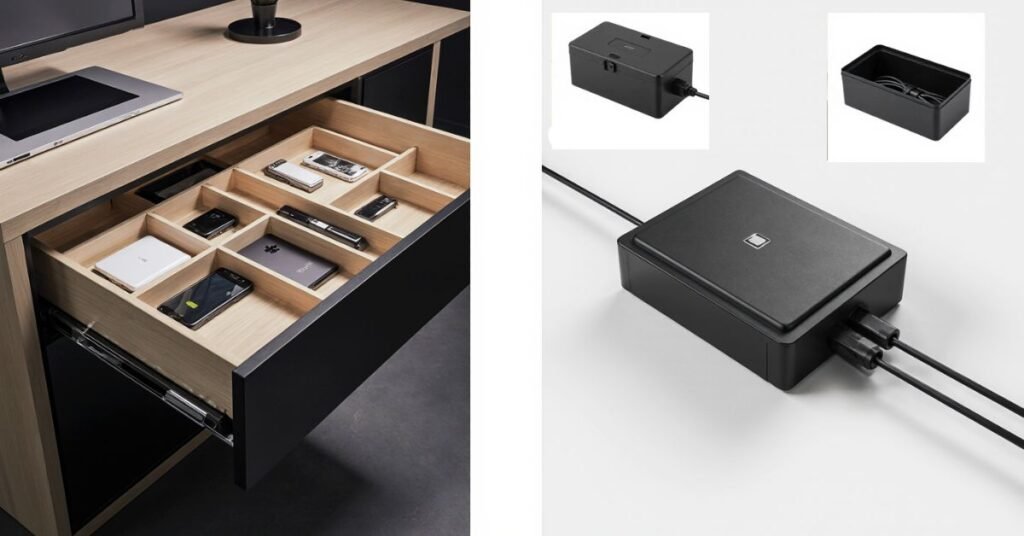
The almost-magical part? How disproportionately satisfying this small change can feel.
You spend twenty minutes and maybe thirty dollars on a simple box or drawer organizer. And suddenly, every time you walk into that room, something that was subtly bothering you has simply… vanished. You don’t consciously think, “Ah, how lovely that my cables are hidden,” or perhaps you do. But for sure, you just feel a little more settled and a little less pulled in multiple directions.
A well-designed cable management box does this while being genuinely practical as it keeps power strips accessible, maintains proper airflow so nothing overheats, and often includes openings for cords to exit cleanly.
This isn’t about achieving some Instagram-worthy, perfectly minimal desk setup. It’s about acknowledging that digital life has “physical consequences” and they pile up really fast. Giving those consequences a proper home, so your spaces can breathe again, is truly amazing! Because here’s the truth: containment creates calm…Not through elimination, but through intention.
6. Upgrade What You Touch Daily (Not Just What Guests See)
Here’s a question worth sitting with for a moment:
When you think about upgrading your home, whose experience are you prioritizing?
It’s an easy trap to fall into, curating for the eyes of others. The guest who might notice your new throw pillows. The friend who compliments your coffee table books. The imagined visitor who will finally appreciate how put-together your space looks.
But here’s the thing about guests: they visit occasionally, but you live in the space every single day. And the objects that shape your daily experience aren’t usually the ones on display. They’re the ones in your hands.
Consider the difference:
- A decorative vase catches the light beautifully, but a well-balanced chef’s knife makes chopping vegetables for dinner feel effortless, even satisfying.
- An art print adds color to the wall; however, a supportive desk chair carries you through an afternoon of work without that familiar ache in your lower back.
- A scented candle creates ambiance. A towel set that actually dries efficiently greets you every morning with simple, quiet competence.
These aren’t necessarily the purchases that make it onto mood boards. But they’re the ones that shape your actual, lived experience.
Why this matters more than you might think:
Small frustrations, repeated daily, don’t stay small. They compound.
A knife that dulls easily, requiring extra pressure every time you use it. A chair that never quite supports your posture, leaving you subtly readjusting all day. Towels that never seem to fully dry, developing that faint musty smell. Each instance is minor. But multiplied across days, weeks, months? That’s a steady, low-grade drain on your attention and mood.
Honestly, upgrading these touchpoints isn’t about luxury. It’s about removing that drain.
What to look for when you upgrade:
When you invest in an object you’ll use daily, the goal isn’t a brand name or a certain aesthetic. It’s how the object performs in your hands.
- A chef’s knife should feel balanced, not blade-heavy or handle-heavy, with steel that holds its edge.
- A desk chair should support the natural curve of your spine, with adjustable height and lumbar support that actually meets your back.
- A cutting board should be substantial enough to stay put while you work, made of a material that’s kind to your knives.
- Towels should be woven densely enough to absorb well, yet dry reasonably fast between uses.
These are the quiet specifications that improve your quality of life in the background. No one will compliment you on them. But you’ll feel the difference every single time you reach for them.
The deeper truth:
Minimalism, at its best, was never really about having fewer possessions. That’s a means, not an end.
The end is this: better interactions with the things that populate your life. Fewer moments of friction. More moments of quiet competence. A home that works for you, not one you’re constantly working around.
Upgrade for the person who lives there every day. That person is you.

7. Bonus Tip: Establish One Intentionally Clear Surface
Here’s an upgrade that costs absolutely nothing.
No shopping. No delivery. No assembly required.
Choose one surface in your home, just one, and commit to keeping it intentionally clear.
Not perfectly empty, necessarily. Not sterile. Just… clear. A small territory of visual calm in an otherwise lived-in space. Maybe it’s your bedside table. A single lamp, nothing else. You wake up to stillness instead of clutter.
Maybe it’s a section of the kitchen counter. A pocket of emptiness between the coffee maker and the fruit bowl. You make breakfast without your eyes darting across a dozen objects.
Maybe it’s a corner of your desk. Just your laptop and a notebook. You sit down to work and immediately feel the relief of uncluttered space.
Why such a small thing matters:
Your brain is constantly processing visual information, whether you’re aware of it or not. Every object in your field of view demands a tiny fraction of your attention, even the ones you’ve long since stopped noticing.
A clear surface is a break from that demand.
It’s a visual rest stop. A place where your eyes (and by extension, your mind) can land without having to process anything. In a world of constant input, this small pocket of nothing becomes unexpectedly precious.
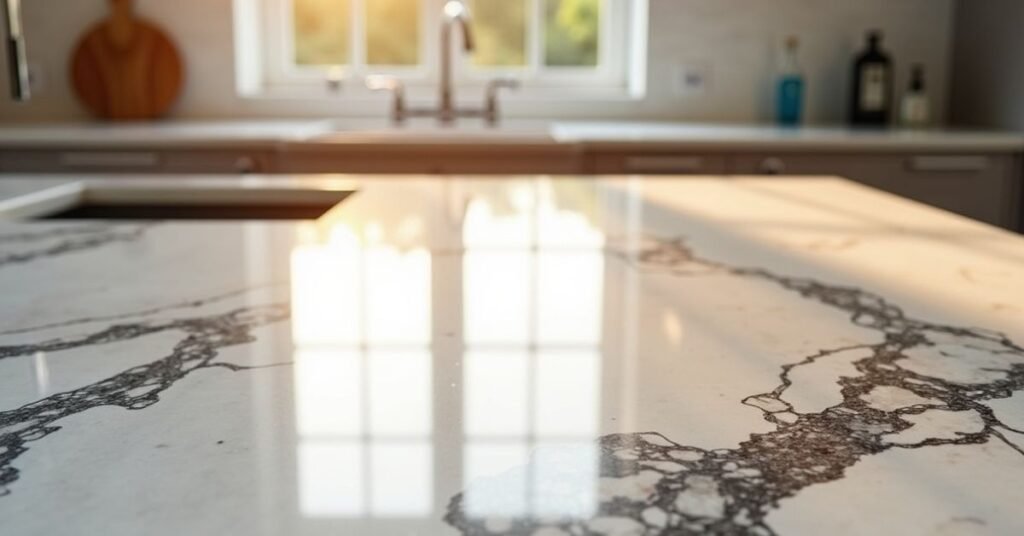
This effect is magnified in smaller homes, where square footage is limited, and surfaces tend to accumulate quickly. A single clear surface creates the illusion of breathing room. It’s a visual expansion pack for your apartment.
The practice matters more than the perfection:
This isn’t about achieving some Instagram-worthy state of emptiness that lasts just for a brief moment before real life intervenes. It’s about the practice of resetting.
You’ll use the surface. Life will happen. Things will accumulate. And then, perhaps at the end of the day or the start of a new morning, you’ll clear it again. That small ritual, choosing to restore order to that one spot, is itself a form of resetting. A way of telling yourself: this space is mine, and I’m choosing how it feels.
The deeper lesson:
Minimalism, in its most accessible form, is sometimes just subtraction. Not adding better things, not reorganizing, not systems and solutions. Just… removing.
One surface. Cleared.
It costs nothing. It takes moments. And it offers, in return, a small but real experience of calm, multiple times a day, every day you choose to maintain it. That’s not deprivation. That’s just giving yourself somewhere to rest.
Why These Upgrades Improve Daily Life
If you look back at the seven upgrades we’ve explored, you might notice something interesting.
None of them is about following a trend.
None requires a renovation or a big budget.
None add decorative objects that need dusting.
Instead, they share three quieter qualities:
They reduce friction.
Not through elimination, but through ease. A knife that cuts cleanly. A chair that supports. A surface that stays clear. Small moments of effort are removed dozens of times a day.
They reduce visual and cognitive noise.
Closed storage for the eyes. Contained cables for the mind. Warm light for the nervous system. These upgrades don’t just change how a room looks; they change how it feels to be in it.
They improve something you experience daily.
Not the guest room. Not the powder room. The spaces you actually inhabit. The objects you actually touch. The rituals that structure your actual days.
In smaller homes, especially, this approach reveals an unexpected truth: restraint produces more noticeable results than expansion.
You don’t need more space. You need less drag within the space you have.
Final Thoughts
Here’s something easy to forget when you’re scrolling through perfectly styled interiors: minimalism was never really about owning less.
That was always just the method. The means, not the end.
The end is this: living with less resistance.
When your environment stops competing for your attention, when it stops asking you to process, to search, to adjust, to tolerate, something shifts. Your energy, once fragmented across dozens of small frustrations, starts to coalesce. It becomes available for other things.
Reading. Thinking. Connecting. Resting.
The minimalist upgrades that make this possible aren’t the dramatic ones. They don’t photograph well. They won’t impress a guest. They’re the quiet ones: the balanced knife, the clear surface, the contained cable, the warm light. They are simply the most meaningful ones.
If small, intentional shifts appeal to you, you might feel at home in our guide to How to Build a Cozy Reading Nook in a Small Apartment. A corner for rest, designed with care.
[…] A kitchen that works better makes daily cooking feel like less of a negotiation. For more small shifts that reduce friction throughout your home, visit Minimalist Home Upgrades That Instantly Improve Daily Life. […]
[…] Minimalist Home Upgrades That Instantly Improve Daily Life — small shifts that reduce friction, room by room […]
[…] A reading nook is one way to invite calm into your home. For more small shifts that reduce friction and restore ease, visit our companion article: Minimalist Home Upgrades That Instantly Improve Daily Life. […]
[…] Minimalist Home Upgrades That Instantly Improve Daily Life […]
[…] Minimalist Home Upgrades That Instantly Improve Daily Life […]